
Leaders’ Message
There are few places in the United Kingdom quite like Devon. Proud, distinctive, full of character and potential. From the bustle of its cities to the calm of its coast and the deep steadiness of its rural heart, Devon carries an energy all of its own - confident yet grounded, modern yet shaped by centuries of history and belonging.
Plymouth and Exeter stand at the heart of that story – Plymouth is the powerhouse and growth hub of the South West and is relentlessly ambitious for its people and for its businesses. Exeter is a compact yet fast growing city with significant impact, helping to power Devon’s growth while staying faithful to its people, communities and heritage.
However, this is not a plan for our cities alone. It is a plan for Devon. A plan to strengthen what already works, to fix what does not, and to build a fairer, simpler, more logical way of structuring local government in this incredible county.
Our case for four unitary councils is compelling and evidence-based, but it is also proudly ambitious. We want more for the communities in our cities, our county, and our country. More opportunity, more growth, and higher living standards for everyone who calls Devon home.
Our cities are where ideas grow, where businesses invest, where research, technology and innovation take root. Cities like Plymouth and Exeter have shown how creating jobs, skills, and prosperity can lift the whole region. But our countryside is just as vital. Its landscapes, its traditions, and its people define who we are and demands a different approach, one that values community over centralisation, care over convenience, place over process.
Our shared vision is simple: a Devon where every child can thrive; where everyone has a home, feels safe and where no one is left behind. A Devon where services are designed around people, not bureaucracy. Where our cities drive growth and innovation and our rural and coastal communities keep their special character. This is one of the most crucial periods in Devon’s history. This is how we build a better, fairer, greener Devon – confident in its purpose, proud of its people, and ready for what comes next.
Cllr Phil Bialyk – Leader Exeter City Council
Cllr Tudor Evans – Leader Plymouth City Council
Principles for the proposal
As well as meeting the six criteria set by the Government, this proposal is built on two additional sets of local principles, developed and tested early-on in the process with local partners and stakeholders. They respond to the Government’s requirement for a single tier of local government and equally importantly, they reflect what matters most for Devon’s future:
-
Any boundary changes for Devon will be appropriate for continuing and new unitary authorities to be financially viable and be of a population size that can deliver sustainable high-quality services to residents.
Any boundary change will retain the character and identity of the existing neighbourhoods across the whole Devon area.
Any boundary change will respect existing unitary county boundaries.
Any boundary change will minimise organisational impacts on National Park Authorities and National Landscapes.
Any boundary change will be based on existing parish boundaries.
Any boundary change will have regard to the requirements for future sustainable growth reflecting the unique growth opportunities in each of the proposed unitary authorities.
Our case for change
Devon is a unique and compelling place to live, work, and visit - two coastlines, two national parks, and landscapes of international importance blended with important national industry, heritage, and cutting-edge technologies. The critical challenge we face across Devon is one of geography. Historic administrative boundaries constrain Exeter, Plymouth and Torbay’s ability to extend across natural communities and functional economic areas, throttling their growth potential. The current district boundaries artificially divide each growth area, making it harder to deliver economic and housing growth.
Devon has an ageing rural population placing huge pressure on public services, contains significant pockets of deprivation, a lack of affordable housing, skills gaps, low wages, and the migration of young people out of the rural areas. Our proposal is structured to address these challenges and avoid creating authorities with undue financial advantage or disadvantage, thus ensuring all areas benefit from appropriately allocated resources and that no community is left behind as Devon transitions to this new governance framework.
What is the proposal?
The Proposal: Four Councils, One Connected Devon.
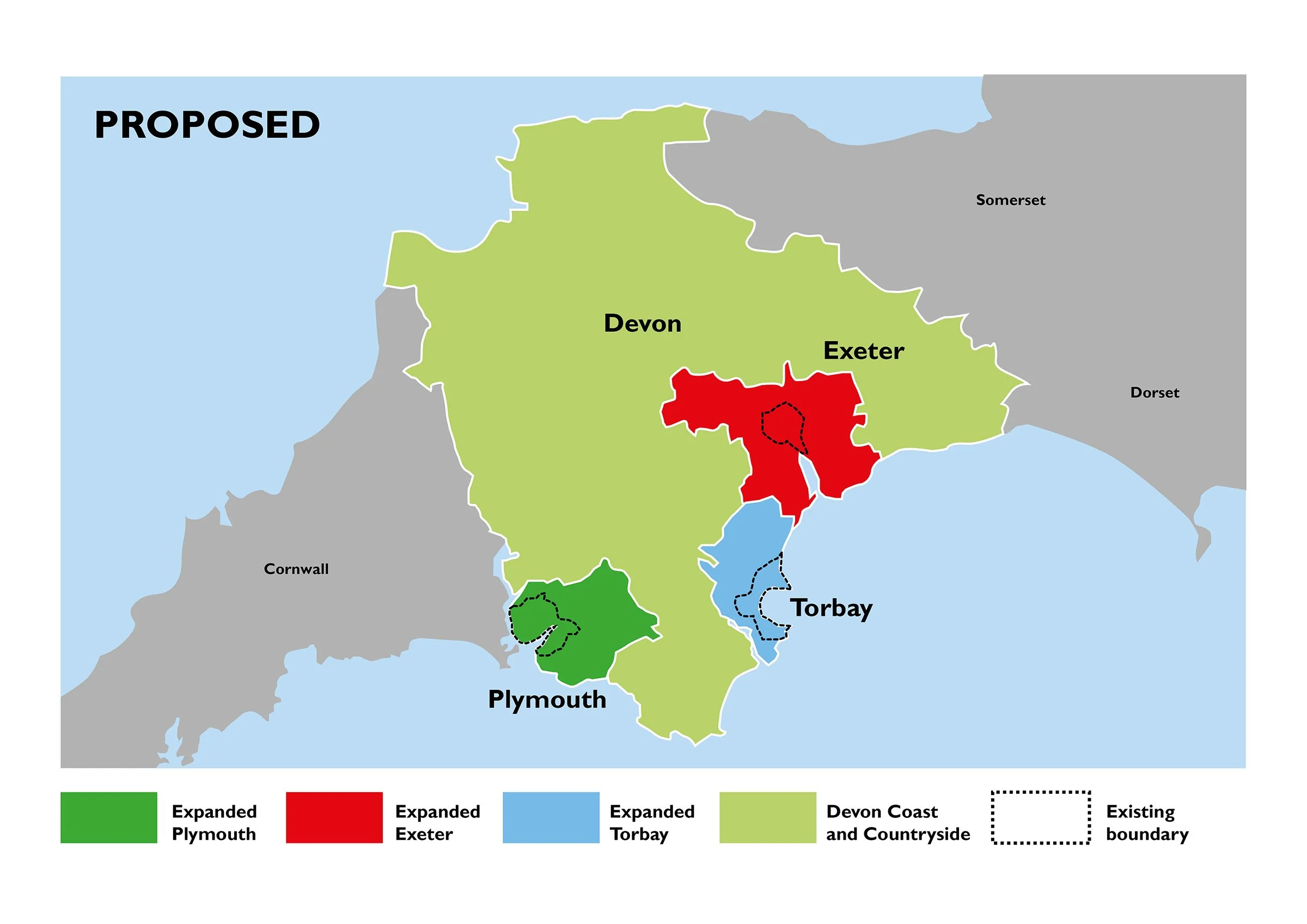
The proposal creates four unitary councils across Devon, each designed to reflect how people live, work and use services.
Expanded Plymouth
Based on the current Unitary Authority expanding to serve communities across the city and surrounding areas that already rely on Plymouth for employment, education and healthcare. A council with the scale to compete nationally and drive growth.
New and Expanded Exeter
A new Unitary Authority based on existing Exeter City Council, expanding into the surrounding parishes to unlock the potential of one of Britain’s fastest-growing cities, giving it the coherence and capacity to plan strategically for housing, transport and economic growth across its natural economic area.
Expanded Torbay
Based on the current Unitary Authority proven success in delivering integrated services, from acclaimed children's services to innovative health partnerships but with an expanded boundary to include surrounding parishes.
New Devon Coast and Countryside
A new Unitary Authority specifically designed for rural and coastal communities, with services tailored to the challenges of dispersed, older, populations, market towns and isolated areas.
What difference would it make?
The current two-tier council system can be confusing and people often aren’t sure which council is responsible for which service. Important decisions are made across several different organisations, which can slow things down and make things less efficient.
In the future, residents will know exactly who to contact for support with things like housing, social care, planning or education. Services will be joined up instead of divided between different councils. Big decisions will be made at the right level - local enough to understand communities, but wide enough to plan properly.
Reorganisation is a chance to change how services work for people. By moving to a single layer of local government with updated boundaries, we can redesign services around residents rather than around organisations. It will help us step in earlier to stop problems getting worse and create genuinely joined up services instead of the fragmented experience people face today.
Stronger local voices
This proposal embeds neighbourhood governance as a formal structure in each new council. Parish councils, ward members, officers and local partners come together in each area to set priorities and influence how resources are allocated.
Neighbourhood governance creates clear mechanisms for communities to shape decisions and gives people who know their area a direct role in determining how it develops.
The detailed arrangements will be subject to future Government regulation and guidance. What matters is the commitment to making it work, smaller unitary councils make this possible because decision-makers are closer to the communities they serve, with the scale to respond to local needs. Proximity brings accountability, when councils make decisions affecting neighbourhoods, we want those neighbourhoods have a genuine say in the process.
Unlocking growth and opportunity
Devon has enormous economic potential, from advanced manufacturing and marine technology to environmental science and the visitor economy. What holds us back is governance that splits effort across boundaries and makes strategic action difficult.
Four unitary councils change that. Housing development gets planned coherently across natural economic areas. Transport infrastructure connects communities based on how people actually travel, not where district lines happen to fall.
This proposal also creates the foundation for meaningful regional devolution. Four constituent councils will form a South West Peninsula Mayoral Strategic Authority, giving Devon a powerful voice at the national level with the ability to secure investment and influence policy across the region.
Why do we believe this model delivers?
Our proposal for Devon strikes the right balance to make the most of the once-in-a generation opportunity to create local government for Devon that is firmly:
Rooted in place and delivering better outcomes - focused on distinct places and able to better manage resources, attract investment and deliver value for money.
Based on real places and economies - functional geographies that support growth and accountability.
Built on fair, sustainable finances - based on a fair and balanced tax base to support financial resilience and aligned governance.
Wrapped around communities – giving them a real voice in decisions through local neighbourhood committees and stronger democratic representation.
Protecting our environment - from our coasts to cities, towns and villages, to our countryside.
Providing simpler, smarter, public services that work better for people – reducing duplication and complexity, delivering better decision making and improved customer experiences.
Practical, phased and ready to deliver - ensuring a logical flow into effective new authorities, with shared strategic need and value placed on working together.