Reimagining Devon
(with modest expansion of Plymouth)
Reimagining Devon: Believe in Better is a bold vision to create three unitary authorities for Devon, reflecting our diverse urban, rural and coastal communities.
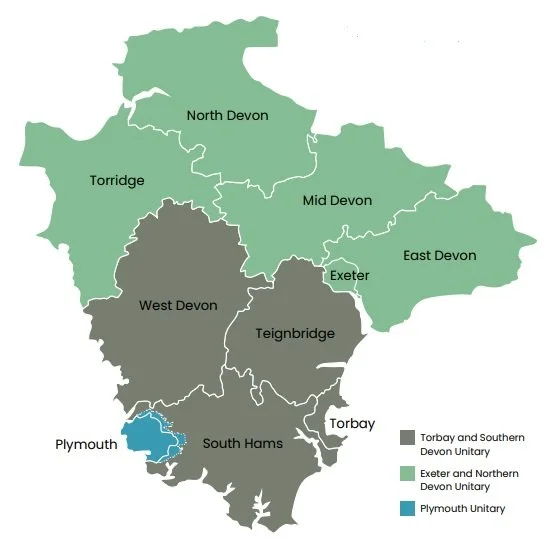
This modified proposal (also known as 4-5-1+) builds on the base case. It still proposes three unitary councils but suggests a modest expansion of Plymouth into the neighbouring South Hams, primarily affecting areas such as Sherford and Woolwell.
Under this proposal the population of each unitary authority changes slightly from those under the base Reimagining Devon Proposal.
These three new unitary councils would be:
Exeter and Northern Devon – covering East Devon, Exeter, Mid Devon, North Devon and Torridge - Population: 546,738
Torbay and Southern Devon – covering the South Hams (excluding the parishes of Bickleigh, Shaugh Prior, Sparkwell and Brixton) limited to those parts of the 4 parishes that fall within the Plymouth Policy Area as defined within the Joint Local Plan), Teignbridge, Torbay and West Devon - Population: 419,555
Plymouth (including the parishes of Bickleigh, Shaugh Prior, Sparkwell and Brixton) limited to those parts of the 4 parishes that fall within the Plymouth Policy Area as defined within the Joint Local Plan) – Population: 275,336
The reasons for proposing this modest expansion are:-
Providing greater growth opportunities for each of the new unitary authority areas
Improving devolution opportunities and allowing for a more balanced voice and scale for the each of the new unitary authorities, ensuring a more even distribution of council tax income and GVA per capital and allowing for each authority to be better positioned to advocate for its local priorities, securing equitable funding and powers from central government.
Limiting the expansion to the Plymouth Policy Area so that it does not cross the Dartmoor National Park boundary, maintaining clarity and coherence in planning authority responsibilities
The modified model offers a potential improvement on the base Reimagining Devon proposal in some respects because it delivers greater balance, stronger alignment with functional geographies, enhanced community engagement, and a more resilient platform for future devolution and service delivery. These improvements are achieved without sacrificing the core strengths of the Reimagining Devon model outlined in the main case — local identity, accountability, and high-quality services.
Proposal Map